
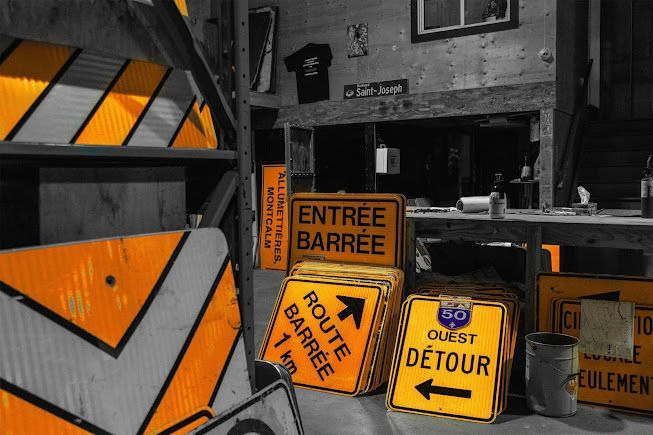
Before any crew steps onto a live roadway, r oad safety measures must already be in place to protect workers, drivers, cyclists, and pedestrians. In practical terms, this means having a clear traffic management plan for the work zone, installing appropriate signage, and ensuring that everyone involved understands how traffic flow will be maintained during the construction.
This preparation is essential because a work zone alters traffic patterns: closed or narrowed lanes, detours, speed changes, the presence of machinery, and worker movements create new risks even before work actually begins. Poor preparation can lead to confusion for road users, dangerous situations, work stoppages, and compliance issues.
For roadwork in Ottawa, Gatineau, Laval, on Montreal’s South Shore, in Kingston, and in eastern Ontario, a thorough pre-construction review allows these risks to be anticipated rather than reacting to them once crews are on site. Here are seven road safety measures to put in place before the first cone is installed.
Measure 1 – Start With a Site-Specific Traffic Control Plan
A traffic control plan is a documented layout showing how vehicles, pedestrians, and cyclists will move safely through or around a work zone. It is the foundation of all road safety measures for construction sites, and it should be completed and approved before any mobilization.
In simple terms, a “work zone” is any part of a roadway where construction or maintenance activities change normal traffic patterns. “Temporary traffic control” or temporary traffic management covers everything you use to handle those changes: signs, cones, flaggers, lane closures, detours, and speed reductions. In Ontario and Quebec, that plan must align with provincial standards such as Ontario’s traffic control device guidelines and Quebec’s safety expectations from bodies like CNESST, plus municipal rules in cities like Ottawa and Gatineau.
Here’s a simple way to prepare a site‑specific traffic control plan before work begins:
- Define the work area, schedule, and type of operations (lane closures, full closures, shoulder work, short‑term repairs).
- Gather road data: speed limit, number of lanes, visibility, nearby intersections, schools, or transit stops.
- Select layouts from relevant manuals, then adapt them to your exact geometry and staging.
- Specify all devices: signs, cones, barrels, barriers, arrow boards, and flagger positions.
- Document roles, communication methods, and escalation steps if traffic backs up or conditions change.
A detailed traffic control plan also makes it easier to brief crews, get municipal approvals, and coordinate with a traffic management company if you choose to bring in a dedicated team.
Measure 2 – Map Vehicle, Pedestrian, and Cyclist Flows and Eliminate Conflict Points
Before construction starts, you should map how vehicles, pedestrians, and cyclists currently move through the site and how they will move once your work zone is in place. The goal is to identify conflict points—places where paths cross or visibility is poor—and design safer alternatives in advance.
This step is often skipped in rushed road construction safety planning, but it is critical on urban arterials in Ottawa, Gatineau, Laval, and the South Shore where you may see heavy transit use, school zones, or bike lanes. Temporary traffic management that only considers vehicles will leave vulnerable road users exposed. Take time to walk the site, ideally at different times of day, and note:
- Main vehicle movements, turning patterns, and typical congestion points.
- Marked and unmarked crosswalks, mid‑block crossings, and desire lines where pedestrians actually walk.
- On‑street bike lanes, multi‑use paths, or informal cycling routes.
Once you see these flows, design work zone safety measures before construction starts, such as:
- Protected pedestrian detours with continuous sidewalks or temporary walkways, not just “Sidewalk Closed” signs.
- Clearly signed and, where possible, physically separated bike detours.
- Turn restrictions or temporary one‑way operations to reduce risky vehicle conflicts near the site.
This kind of advance mapping turns a basic traffic control plan into a more complete construction site safety strategy that truly protects everyone, not just drivers.
Measure 3 – Deploy Compliant Signs, Cones, and Barriers Before Crews Arrive
One of the most effective road safety measures for construction sites is to have all temporary signs, cones, and barriers fully installed and checked before the first work truck arrives. Drivers should already be slowing down and following your directions the moment crews start setting up.
In practice, that means treating equipment deployment as its own operation within your work zone traffic control plan. Devices must follow provincial and municipal specifications for size, reflectivity, language, and placement. Ontario uses standardized devices similar to MUTCD‑style guidance, while Quebec projects must also meet bilingual signage requirements as reflected in guidance from CNESST and provincial transport authorities. Around the Ottawa–Gatineau region, that often means English‑French temporary signage, especially on cross‑provincial projects.
Before work begins, ensure you have:
- Advance warning signs for “Road Work Ahead,” lane shifts, speed reductions, and detours.
- High‑visibility cones or delineators (including distinctive options like the purple cones widely recognized in Quebec work zones).
- Barrels, barricades, or temporary barriers to physically separate traffic from workers where speeds are higher.
- Arrow boards or portable message signs to guide lane merges and closures.
Set these up in the sequence defined in your traffic control plan, then drive the route at normal speed to confirm that messages are clear and visible. Many teams rely on a dedicated traffic control company, such as Prosign, to handle this deployment so that construction crews can focus on their core work.
Measure 4 – Protect Workers With Training, PPE, and Clear On-Site Roles
Even the best road safety measures will fail if workers are not trained, visible, and clear on their responsibilities. Before any construction site opens, you need to confirm that people understand the work zone layout, know how to communicate, and are equipped with appropriate personal protective equipment.
A solid construction site safety setup starts with a pre‑work briefing or toolbox talk. Walk through the traffic control plan, review ingress and egress for trucks, and point out escape routes if a vehicle enters the work area unexpectedly. For flaggers and traffic control persons, ensure they have completed required training.
Before the shift starts, confirm that:
- All workers wear high‑visibility garments that meet current standards, plus hard hats, safety boots, and other PPE suited to the job.
- Flaggers have reliable two‑way radios or communication devices, not just hand signals.
- Roles are defined: who can adjust signage, who speaks with police or municipal staff, and who makes the call to shut down work in unsafe conditions.
Measure 5 – Plan for High-Risk Conditions: Night Work, Bad Weather, and Emergency Access
Some of the highest‑risk periods for road construction safety are at night, in bad weather, or when emergency vehicles need fast access through or around your work zone. Planning for these conditions before work begins will prevent last‑minute improvisation when visibility drops or a storm rolls in.
In Ontario and Quebec, winter and shoulder‑season projects must consider snow, slush, and reduced daylight. Slippery surfaces can make it harder for drivers to slow down when they encounter temporary traffic management devices. Reflective signs and high‑intensity flashing beacons become even more important in these conditions. For night work in busy corridors around Ottawa, Gatineau, Laval, and the South Shore, you’ll also need to think about work lighting that illuminates crews without blinding drivers.
Before the first shift, document how you will:
- Upgrade visibility for night work (additional lighting, higher‑grade reflective materials, illuminated signs where needed).
- Adapt to weather, including snow buildup around cones and barriers or puddles that obscure pavement markings.
- Maintain clear routes for emergency vehicles, with pre‑planned access points and contact information for local police, fire, and EMS.
These plans should live inside your overall road work safety plan and be reviewed with both the construction team and any traffic control provider involved.
Measure 6 – Communicate Early With the Public, Stakeholders, and First Responders
Effective communication is a road safety measure in its own right. When drivers, residents, and first responders know what to expect before construction starts, they are less likely to make sudden, risky decisions around your work zone.
For projects in Ottawa, Gatineau, and other municipalities, this often means coordinating with city communications teams to push information through official channels. Clear, timely messaging can significantly reduce driver surprise and frustration, which are considered contributing factors to many incidents in construction zones. For longer‑term work, consider a simple microsite or map showing detours and timelines.
Before the first lane closure, confirm that you have:
- Portable or fixed message signs deployed several days in advance for major closures or detours.
- Notices to nearby businesses, residents, and institutions (schools, hospitals, transit agencies) describing expected impacts.
- Direct communication with police, fire, and EMS so they understand lane configurations and alternate routes.
Good communication is also internal. Make sure site supervisors, traffic control crews, and municipal contacts know how to reach each other 24/7 if conditions change or complaints arise.
Measure 7 – Partner With a Dedicated Traffic Control Team for Deployment and Adjustments
Managing work zone traffic control in‑house can work for very small, low‑risk projects, but more complex road work often benefits from partnering with a specialized traffic control company. This is especially true when you need rapid deployment, bilingual signage, or 24/7 support across multiple sites in Ontario and Quebec.
A dedicated traffic control provider can turn your road work safety plan into a full service: planning, equipment selection, installation, active monitoring, and takedown. They bring crews who live and breathe temporary traffic management, understand local regulations, and know how to adjust layouts safely when traffic behavior or conditions change. Many agencies also offer distinctive, highly visible equipment—such as recognizable purple cones used in parts of Quebec—that helps drivers instantly identify a professional work zone.
Here is a simple comparison between handling traffic control yourself and working with a specialized partner:
| Aspect | DIY Traffic Control | Specialized Traffic Control Partner |
| Planning time | High; project team must create and review plans themselves | Lower; templates and experience speed up plan development |
| Compliance risk | Higher if team is unfamiliar with Ontario/Quebec standards | Reduced; crews work daily with local rules and expectations |
| Response time to issues | Depends on construction crew availability | Dedicated teams can adjust layouts and devices quickly |
| Worker safety | Construction staff juggle traffic and production tasks | Traffic control is handled by people focused solely on that role |
For many municipal and contractor teams, outsourcing traffic control means fewer headaches, stronger construction site traffic management, and a consistent work zone safety checklist applied from project to project.
Turn These Road Safety Measures Into a Pre-Work Checklist
Implementing road safety measures before construction begins protects workers and road users, reduces the risk of non-compliance, and keeps operations on track. A clear signage plan, identification of different traffic flows, installation of equipment before crews arrive, and preparation for more complex conditions allow safety to be integrated into the project from the outset, rather than reacting to problems once construction is underway.
For municipal teams and contractors working in Ottawa, Gatineau, Laval, on Montreal’s South Shore, in Kingston, and in Eastern Ontario, Prosign can support this preparation and the implementation of temporary traffic management. When a construction site involves busy intersections, night work, lane closures, or significant detours, a specialized team can help plan and deploy the necessary measures based on the project requirements.
Good preparation means fewer unforeseen events, better traffic management, and a safer worksite from day one. Contact Prosign to plan traffic management for your next construction site and put in place the necessary road safety measures before work begins.
FAQ: Quick Answers for Project Managers and Municipal Teams
What are the essential road safety measures to implement before starting construction work?
The essential road safety measures before starting construction work are a site‑specific traffic control plan, pre‑installed signage and devices, trained personnel, and clear communication with the public and emergency services. Together, these steps ensure that drivers and vulnerable road users encounter a predictable, well‑managed work zone from day one.
In practice, that means planning temporary traffic management layouts, mapping all road user flows, deploying advance warning signs and cones before crews arrive, and briefing workers on roles and PPE. For higher‑risk or complex projects in Ontario and Quebec, many teams also involve a traffic control company early to validate the plan and handle deployment.
What is a traffic control plan and why do you need one?
A traffic control plan is a documented diagram and set of instructions that show how traffic will move safely through or around your work zone. You need it to comply with provincial and municipal requirements and to reduce confusion and collisions once construction starts.
The plan typically includes device types and locations, lane configurations, speed changes, detours, and flagger positions. Agencies like the Canadian Centre for Occupational Health and Safety highlight the importance of such planning as a core element of work zone traffic control. Without a traffic control plan, crews may improvise signage and lane closures, creating inconsistent and unsafe conditions.
What signs, cones, and barriers are required at a road work site?
Required signs, cones, and barriers at a road work site depend on speed limits, road type, and jurisdiction, but usually include advance warning signs, speed reduction signs, lane closure or shift signs, cones or delineators, and, on higher‑speed roads, barrels or temporary barriers. These devices must meet size, reflectivity, and placement standards set by provincial and municipal authorities.
For example, Ontario work zones follow guidance similar to that in the MTO’s sign standards, while Quebec projects must also respect bilingual or French‑language rules in addition to safety criteria from bodies like CNESST. A traffic control provider can help you choose compliant devices and position them correctly before work starts.
How can we protect pedestrians and cyclists around construction sites?
The best way to protect pedestrians and cyclists is to map their usual routes and then create continuous, well‑marked detours with physical separation wherever possible. Clear signage, good lighting, and barriers that prevent encroachment by vehicles are key.
For urban projects—like lane closures in downtown Ottawa or near riverfront paths in Gatineau—consider temporary sidewalks, protected bike lanes, or shared‑use paths that keep people away from active work areas and heavy equipment. These measures should be part of your work zone safety checklist and installed before any lane closures take effect.
When should we hire a traffic control company instead of managing it internally?
You should consider hiring a traffic control company when the road is busy, the geometry is complex, the closure is long‑term, or you lack in‑house expertise with work zone standards in Ontario and Quebec. Bringing in specialists is also wise for night work, highway projects, or cross‑provincial sites that require bilingual signage.
In those situations, a dedicated provider, such as Prosign, can develop or refine your traffic control plan, supply compliant equipment, deploy and adjust devices, and offer 24/7 support if conditions change. That support lets your construction team focus on production while knowing that temporary traffic management is being handled by people who work in this environment every day.